

Engineering Digital
Transformation with
Intelligence
We transform businesses through software innovation and intelligent systems. We enable digital transformation by combining deep engineering capabilities with a strong understanding of business, operational, and industry-specific realities.
The Invisible Tax: Why Your 2026 Product Roadmap Is Stalling
25 April 2026.
Reading Time: 4 Minutes
TL;DR
In 2026, senior engineers at companies running aging architectures spend 25–40% of their time maintaining legacy code rather than building new capability. The Invisible Tax slows GTM cycles more than any talent, funding, or AI-model constraint. The fix starts with diagnosis, not rewriting.
It is April 2026. Two years ago, the mandate across every executive suite was singular: get AI into the product. Teams moved at breakneck speed, layering LLM wrappers, vector databases, and real-time inference engines onto their existing stacks. The market responded. The AI honeymoon was real.
Today, the conversation in engineering standups has changed. The quick wins of 2024 have been replaced by the structural bottlenecks of 2026.
Why is the product roadmap slipping even though R&D spend is up?
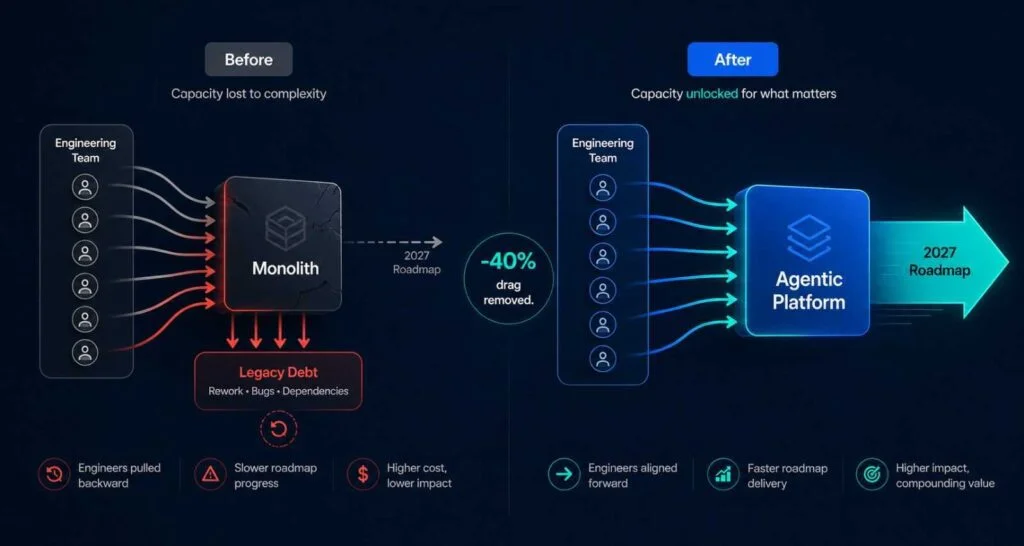
As a CTO, you see an R&D budget that has ballooned while GTM velocity has slowed. As an Engineering Leader, you watch senior architects the people hired to lead the next generation of autonomous agentic systems spend their days on Architectural Archaeology: excavating code written years earlier to ensure a new API call doesn’t trigger a cascading failure across the monolith.
They are not building for 2027. They are digging through 2018.
What is the Invisible Tax?
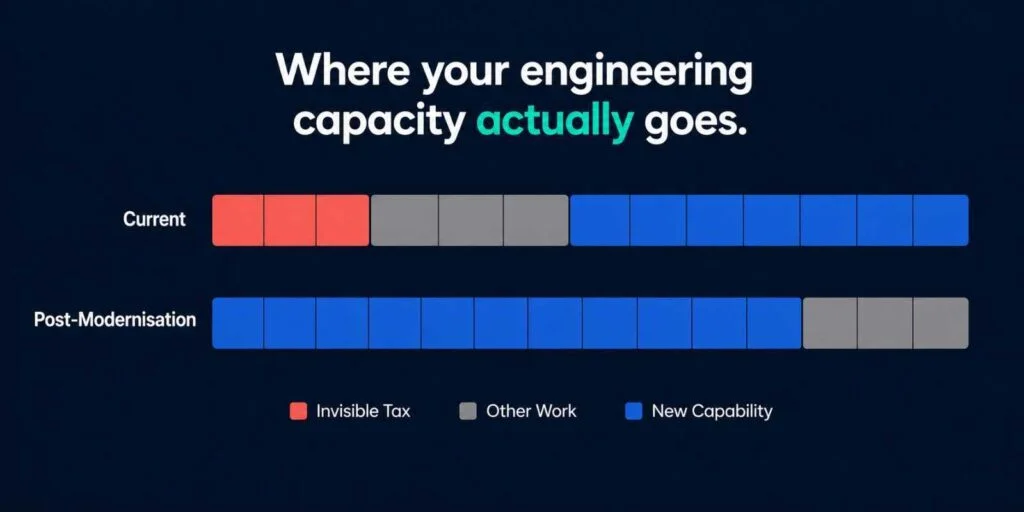
The Invisible Tax is the portion of engineering capacity consumed by legacy maintenance rather than new capability.
Research places technical debt at 21–40% of total IT spending. In plainer terms: for every ten engineers on your payroll, three to four are effectively working for the past, not the future.
A move from engineers spending 75% of their time paying the tech debt tax down to 25% after restructuring how debt was managed. That reclaimed capacity became the foundation of the company’s competitive position today.
Why top architects are leaving
For engineering leadership, this is a talent retention problem. Senior engineers did not join to maintain spaghetti code. They joined to build agentic workflows, multi-modal interfaces, and real-time data orchestration. When half the week is spent on keep-the-lights-on work, burnout is not a risk it is a certainty. In a 2026 talent market where the best engineers can pick roles building the agentic future, Architectural Archaeology is the fastest path to attrition.
For the CTO, it is a capital allocation problem. You are paying a premium for innovation and receiving maintenance. When competitors on cleaner architectures ship in two-week sprints while your team needs six weeks for a minor release, the gap stops being technical. It becomes commercial.
What actually stops you from modernizing?
The honest answer: fear of the Big Bang migration. Most CTOs have seen or heard of multi-year rewrites that promised a cloud-native rebirth and delivered three years of downtime, overages, and zero new business value.
88% of business transformations fail to achieve original ambitions.
The fear of repeating that makes patching the monolith feel like the safe choice.
It isn’t. Inaction at this scale is not a delay. It is a decision to let the market pass you by.
What you reclaim when the tax is removed
The Velocity Dividend is the engineering capacity reclaimed when structural drag is removed. It doesn’t come from a rewrite. It comes from a diagnostic-first approach that treats modernization as a systems engineering problem one that follows the principle of understand first, build second.
By surgically addressing bottlenecks in core architecture instead of wholesale replacement, organizations working with structured modernization approaches typically report 30–40% effort reduction vs. unguided migrations.
More importantly, you reclaim that 40% of lost bandwidth. Imagine what your 2027 roadmap looks like when your senior architects are fully focused on building the agentic, autonomous future of your platform rather than excavating the past.
What to do this quarter
The first step is diagnostic, not rewrite. Before a line of code changes, map where the Invisible Tax is actually being paid
- Which services are stable and deliver value? (Retain them.)
- Which carry dead weight — unused features, dormant integrations? (Retire them.)
- Where are the bottlenecks throttling your AI agents and GTM velocity? (Refactor these, surgically.)
Frequently Asked Questions
What is the Invisible Tax?
The portion of engineering capacity currently 25–40% in organizations with aging architectures, consumed by legacy maintenance instead of new capability.
Is 40% of engineering time really lost to technical debt?
Technical debt is calculated at 21–40% of IT spending, which puts engineering time lost at 25–42%. The exact figure varies by industry and architecture age, but the range is well-established.
Does modernization require a Big Bang rewrite?
No. Structured, practitioner-led modernization typically delivers 30–40% less effort than unguided or wholesale migrations. The fix starts with diagnosis not demolition.