
Engineering Digital
Transformation with
Intelligence
We transform businesses through software innovation and intelligent systems. We enable digital transformation by combining deep engineering capabilities with a strong understanding of business, operational, and industry-specific realities.
The Safety Net We Build in Week 1 of Every Migration
20 May 2026.
Reading Time: 3 Minutes.
Every framework migration ships with the same hidden failure mode:
1) Feature tests prove the system does what it should.
2) A migration needs tests that prove the system still does what it did.
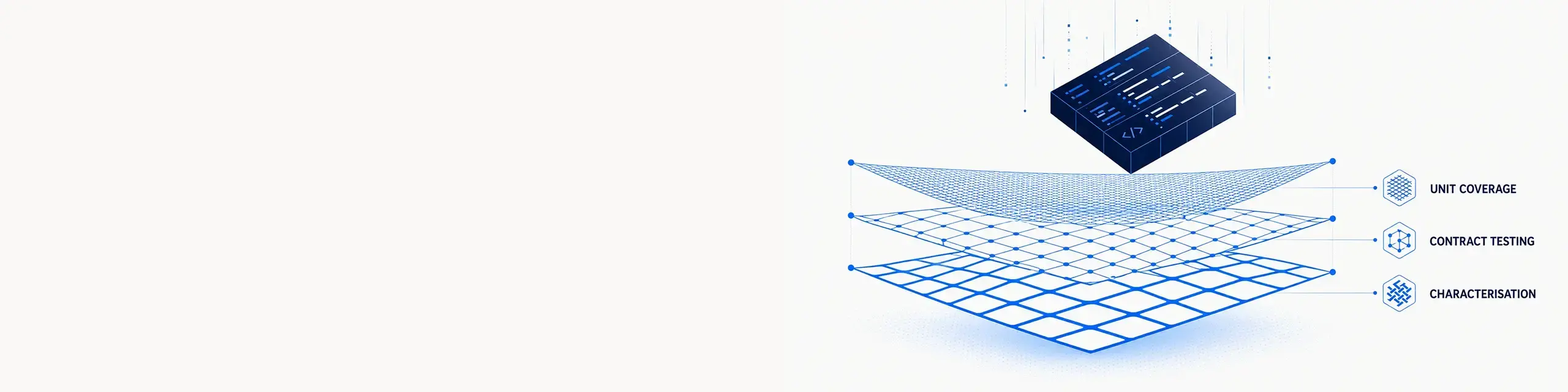
The Safety Net is three reinforcing layers built in the first week of every engagement, before any framework code is touched:
1) Unit-level coverage of the application.
2) Contract testing at every boundary.
3) Characterisation tests at the seams.
The go/no-go gate is around 60 percent line coverage with contracts green and characterisation baselines approved. Below the gate, the migration does not start.
What kind of tests does a framework migration actually need?
Most enterprise test estates were built to prove that features work, not to catch what changes when the framework underneath them moves. Those are different jobs. Feature tests assert correctness in the language of the user story. A migration needs regression detection at the seams: tests that pin down current observable behaviour with enough precision to catch silent deviations the framework upgrade introduces.
These deviations are not bugs in the new framework. They are subtle changes in how data is serialised, how validation fires, how transactions commit, how events order. Whether the migration is Spring Boot 2.x to 3 or 4, Java EE off WebLogic or WebSphere, or a Java version uplift to 21 or 25 LTS, the seams that move are the same: serialisation defaults, transaction semantics, validation timing, the contract every other system depends on.
Feature tests prove the system does what it should. A migration needs tests that prove the system still does what it did. Most estates have only the first.
What are the three layers of the Safety Net?
Three reinforcing layers, in this order: unit coverage of the application code, contract testing at every external boundary, and characterisation tests at the seams where framework behaviour becomes consumer-observable. Each layer catches what the others miss.
- Unit coverage at speed. Three AI-assisted paths for Java unit-test generation are credibly used in 2026. DiffBlue Cover autonomously generates JUnit tests and handles Spring Boot @MockBean layering common in legacy estates. GitHub Copilot for Java with the App Modernization extension runs in agent mode against Maven or Gradle projects with coverage delta reporting. Amazon Q Developer's /test command generates JUnit and Mockito tests in-IDE. Where none fits, developer-led generation against the live application is the fallback. The point is bulk regression coverage of current behaviour, not the choice of vendor.
- Contract testing at every boundary. Wherever the application talks to another system, the API behaviour the other side depends on is locked down before the framework moves. Pact JVM implements consumer-driven contracts for REST and message-based services; Spring Cloud Contract is the Spring-native alternative. For legacy SOAP endpoints, SoapUI sits as a separate track with WSDL coverage at 100 percent of operations. This is the highest-value test type during a framework migration: most production incidents trace to a producer-side serialisation change no consumer team knew about.
- Characterisation at the seams. Tests that record what the current system does, so any future change becomes visible. RestAssured or MockMvc with Verify or ApprovalTests.Java capture response payloads as snapshots that survive the upgrade. Testcontainers runs persistence snapshots against a representative database container, not an in-memory substitute. Arquillian provides in-container characterisation when lifting off a Java EE server. Critical seams: every transaction boundary, every serialisation default, every payload crossing a process boundary.
What questions should the team answer before Week 1 starts?
Week 1 is not a generic sprint. Its shape depends on the estate, the framework versions in play, and what the current test infrastructure can credibly cover. Five questions, ideally answered jointly by the Engineering Manager, the QA Lead, and the Technical Lead before the engagement begins.
- Current line coverage against the migration target, measured? A current JaCoCo measurement against the codebase as it stands today. Not estimated. Not reported from a stale CI run. The gap to 60 percent line coverage is the most important Week 1 sizing input.
- Where are the external boundaries, and which have contract tests? REST endpoints, messaging topics, SOAP services, database procedures. A boundary without a contract test is where a silent regression will originate.
- Which AI-assisted test generation path is realistic for this codebase? Three credible paths in 2026: DiffBlue Cover for legacy estates with thin coverage; GitHub Copilot for Java with the App Modernization extension for codebases the team is actively working in; Amazon Q Developer’s /test command for teams already on AWS. Pick the path before Week 1; the choice sets unit-coverage velocity for the engagement.
- What is the build pipeline currently capable of running? If the existing CI cannot run the new test suite reliably on every commit, the test suite is theatre. Week 1 has to include any pipeline work needed to make the new gates enforceable.
- Are there workloads where the gate has to be higher than 60 percent? Regulated workloads (payments, healthcare, regulated financial reporting) need higher coverage and additional evidence chains. Identify these now and scope Week 1 against the highest threshold in the estate, not the average.
What is the go/no-go gate, and what sits alongside coverage?
None of the above matters without a hard threshold. A Safety Net that is mostly built is not a Safety Net. It is a list of unfinished work that gets skipped under deadline pressure.
THE COVERAGE THRESHOLD THAT MATTERS
Before any module migration begins, measured by JaCoCo against the codebase as it stands today. 80 percent can mask weak assertions; 55 percent with strong characterisation catches regressions that 90 percent without seam tests misses. Below 60 percent, framework-drift detection becomes unreliable.
Three other gates sit alongside coverage, all of which must also pass:
- Contract verification green for every external boundary: SoapUI WSDL coverage at 100 percent of operations, Pact verification green for every consumer-provider pair.
- Characterisation baseline approved and checked into source control, with diff tooling in CI so any future change against the snapshot is visible at review time, not at cutover.
- Non-functional baseline captured for p50, p95, p99 latency under representative load, with the acceptable post-cutover regression band agreed and documented
Below any of these thresholds, the migration does not start. The decision is made jointly by the Engineering Manager, the QA Lead, and the Technical Lead, recorded in steering committee minutes.
Why does the discipline pay back?
Most production incidents in framework migrations are not engineering failures. They are missing-harness failures: the framework moved, the behaviour drifted, and the regression escaped because nothing was watching the right seam.
The discipline reads like overhead. It is the opposite. Every framework migration shipped without the Safety Net has produced incidents that trace back to the missing harness, and the cost has consistently exceeded what Week 1 would have cost.
Frequently Asked Questions
Why around 60 percent line coverage?
Coverage is a proxy for regression-detection capability, not an end in itself. 80 or 90 percent can mask weak assertions that only verify the code ran. Around 50 percent paired with strong characterisation at the seams has been observed to catch regressions that most without seam tests misses. Close to 60-70 percent figure is the working threshold below which framework-drift detection becomes unreliable. Regulated workloads need a higher gate.
What if the team is already using a different AI-test-generation tool?
The three named paths (DiffBlue Cover, GitHub Copilot for Java with the App Modernization extension, Amazon Q Developer) are the ones credibly used in 2026 for bulk Java unit-test generation against legacy estates. If the team has a working alternative that produces JUnit tests at sufficient velocity, the tool choice does not matter. What matters is bulk regression coverage of current behaviour before any framework transformation begins.
What happens if Week 1 doesn't get the team to the gate?
Week 1 extends. The migration does not start until the gate is met. The decision to extend versus start is made jointly by the Engineering Manager, the QA Lead, and the Technical Lead, recorded in steering committee minutes. Under deadline pressure, the gate is the first thing teams talk themselves out of.