

Three Java facts about to collide in 2026
25 May 2026.
Reading Time: 4 Minutes.
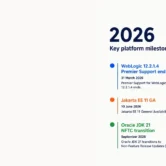
Three things about the Java enterprise stack converge in 2026, and most planning calendars do not yet reflect it:
1) WebLogic 12.2.1.4 Premier Support ends December 31, 2026. WebLogic 14.1.1 is not planned to be an LTS or terminal release. The next LTS is unscheduled.
2) Jakarta EE 11 (June 2025) has stabilised on the jakarta.* namespace with a Java 17 baseline and Java 21 runtime. WebLogic 15.1.1 supports Jakarta EE 9.1 only. The platform gap between WebLogic and the modern enterprise Java specification is roughly five years.
3) Java 21 NFTC free use on Oracle JDK ends September 2026. From that point, estates on Oracle JDK can either move to Java 25 LTS (free under NFTC for one more year) or switch JDK distribution to an OpenJDK build (Eclipse Temurin, Amazon Corretto, Microsoft Build of OpenJDK, Red Hat OpenJDK, Azul Zulu).
Individually, each is an engineering problem with a known answer. The planning window for the target runtime architecture and JDK distribution sits inside the next 12 to 24 months.
Where does the Oracle JDK roadmap sit in 2026?
WebLogic bundles a certified JDK. For most estates, that has been Oracle JDK 8, 11, 17, or 21. Per Oracle’s published Java SE Support Roadmap, Oracle JDK 21 transitions from the free No-Fee Terms and Conditions licence to the Oracle Technology Network licence in September 2026. Updates after that point require an active Oracle Java SE Universal Subscription or a switch to a different distribution.
Oracle JDK 25 LTS (September 2025) extends the NFTC free window by one LTS cycle, until September 2027. Beyond that, the same transition repeats. The alternative is to leave the Oracle distribution. OpenJDK builds from Eclipse Adoptium (Temurin), Amazon Corretto, Microsoft Build of OpenJDK, Red Hat OpenJDK, and Azul Zulu are TCK-certified, production-ready, GPL-with-classpath-exception licensed, and functionally equivalent on the same JDK version; the difference is who ships the binaries and on what licence.
The Oracle Java SE Universal Subscription, in effect since January 2023, is per-employee: the rate ($5 to $15 per employee per month with 8 percent annual escalation) multiplies by the entire workforce regardless of who actually runs Java. For estates with any Oracle JDK footprint, that makes the JDK choice an active decision rather than a deferred one. The decision itself is technical: pick a distribution, pin the version in CI, standardise builds.
Where does the WebLogic version roadmap actually land?
WebLogic 12.2.1.4 is the long-term release that most enterprise estates standardised on. Per Oracle’s Lifetime Support Policy, 12.2.1.4 Premier Support ends December 31, 2026. After that, only Extended and Sustaining Support remain. Extended Support continues quarterly patches for a limited window; Sustaining Support is reactive only, with no new updates or security fixes. For estates running production workloads, the no-security-patches state is the operative constraint.
The successor question is the one with the least clean answer. The Oracle-documented options for 2026:
- WebLogic 14.1.1: Oracle has explicitly stated 14.1.1 is not planned to be an LTS or terminal 14.1.x release. A subsequent 14.1.x LTS is planned but unscheduled. Moving from 12.2.1.4 to 14.1.1 is a runtime change without a destination.
- WebLogic 15.1.1: released late 2025, supports Jakarta EE 9.1 (the namespace change, not Jakarta EE 11). For applications still on javax.*, the namespace migration becomes mandatory as part of the upgrade. This is the only WebLogic version that meaningfully advances the platform position.
- Migration off WebLogic: the alternative is a different enterprise Java runtime. Each is its own engineering programme, but each removes the WebLogic version-roadmap question.
Extended Support beyond December 31, 2026 is the bridge most large estates buy while the migration runs. For compliance-bound estates (PCI DSS 4.0.1, NIST SSDF, EU DORA, SEC S-K Item 106), running long-term on a version without security patches is not where most teams want to be.
What does Jakarta EE 11 mean for WebLogic Java EE applications?
Jakarta EE is the successor to Java EE, transferred from Oracle to the Eclipse Foundation in 2017 and released under the jakarta.* namespace from Jakarta EE 9 (2020) onwards. Jakarta EE 11 was released on June 26, 2025 with Java 17 baseline and Java 21 at runtime, shipping the Jakarta Data specification and first-class virtual thread support.
For WebLogic estates, the namespace question is load-bearing. Java EE 8 (2017) was the last release on javax.*; every release since is jakarta.*. WebLogic 12.2.1.4 and 14.1.1 are Java EE 8 / javax.* servers and do not support the jakarta.* namespace at all. WebLogic 15.1.1 supports Jakarta EE 9.1, which is the namespace change applied to the Java EE 8 feature set; it does not bring Jakarta EE 10 or 11 features. The implication: WebLogic, as currently shipping, is roughly five years behind the Jakarta EE specification.
Why does 2026 push the three decisions together?
Each fact in isolation has a workaround. Together they remove most of the workarounds
- Oracle JDK 21 NFTC transition alone: switch JDK distribution to Eclipse Temurin, Amazon Corretto, or equivalent. Mechanically straightforward; pin the version in CI and rebuild.
- WebLogic Premier Support alone: buy Extended Support for 12.2.1.4 and continue receiving quarterly patches for one to three more years. Bounded but viable.
- Jakarta EE 11 alone: stay on Java EE 8 / javax.* indefinitely. WebLogic 12.2.1.4 keeps running on the existing namespace and feature set.
In 2026 the three workarounds compete for the same engineering capacity. A single coherent programme that addresses all three is easier to budget, staff, and sequence than three uncoordinated ones running in parallel.
What does an integrated plan look like?
Most estates that complete on a 12 to 24 month timeline structure the work around a single architectural decision and then sequence the dependent changes:
- Architectural decisions: target runtime (WebLogic 15.1.1, a modern Jakarta EE 11 server, or Spring Boot) and JDK (Eclipse Temurin and Amazon Corretto are the most common OpenJDK choices; Java 21 LTS is the typical target in 2026).
- Sequence 1, namespace migration: javax.* to jakarta.* with automated tooling (Eclipse Transformer or OpenRewrite recipes), validated against a characterisation test suite that locks down current behaviour before any migration code is written. The test suite is the single most under-scoped piece of a Java EE migration; the cost of getting it wrong is discovering production-affecting behaviour changes after cutover.
- Sequence 2, runtime migration: WebLogic 12.2.1.4 to the chosen target. Strangler-fig deployment or shadow-traffic validation reduces cutover risk on larger applications.
- Sequence 3, JDK distribution swap: Oracle JDK to the chosen OpenJDK distribution, pinned in CI and validated against the characterisation test suite. Mechanically simple, but coverage has to be complete: every system where a JDK is installed (development, test, production, build agents, third-party application bundles).
What does the decision worth making this quarter look like?
The decision that has to land before the next budget cycle is the target runtime architecture, with the JDK distribution as the dependent choice. Three operating positions are defensible:
- Stay on WebLogic, upgrade to 15.1.1: for estates with deep Oracle Fusion Middleware integration (OBIEE, Identity Management, Forms and Reports) where the Oracle middleware stack is itself the application platform. 15.1.1 + Jakarta EE 9.1 + Java 21 OpenJDK is the most credible plan; the namespace migration ships alongside the WebLogic upgrade.
- Migrate to a Jakarta EE 11 server: for estates where WebLogic is a Java EE runtime choice rather than an integration platform, Open Liberty, WildFly, Quarkus, Helidon, or Payara deliver Jakarta EE 11 today. Migration is heavier than 12.2.1.4-to-15.1.1 but lands on the current specification with five years of runway.
- Migrate to Spring Boot: for estates where the value is the application code rather than the Java EE platform, Spring Boot 4 (Jakarta EE 11 aligned, November 2025) on a JVM-native deployment removes both the WebLogic and the Jakarta EE versioning questions. Larger architectural shift, but the resulting platform is the most actively maintained in the Java ecosystem.
The framework for the decision is technical: which target fits the team’s existing skills, the estate’s integration profile, the application’s architecture, and the budget realistically available over the next 12 to 24 months. The compliance and licensing pressures set the timeline; they do not determine the runtime.
Frequently Asked Questions
Is Extended Support for WebLogic 12.2.1.4 a viable bridge into 2027?
Yes, with conditions. Extended Support continues quarterly patches and security updates for one to three years past Premier Support end. As a bridge during a migration in flight, it is a legitimate engineering position. As a destination, it has limits: the support window is bounded, the platform stays five years behind the Jakarta EE specification, and the talent and tooling gaps that motivated the migration are unchanged by paying for extended patches on the existing version.
Should organisations stay on WebLogic 14.1.1 or move directly to 15.1.1?
15.1.1 if the namespace migration is being done anyway; 14.1.1 only as a brief staging post. Oracle has explicitly stated 14.1.1 is not an LTS or terminal 14.1.x release, so moving 12.2.1.4 to 14.1.1 buys time without finality. 15.1.1 forces the javax-to-jakarta migration but lands on the current LTS, and the namespace work is not wasted later.
Can WebLogic 12.2.1.4 run on an OpenJDK distribution rather than Oracle JDK?
Yes. WebLogic 12.2.1.4 and later certify multiple JDK distributions, and the OpenJDK builds from Eclipse Temurin, Amazon Corretto, Microsoft Build of OpenJDK, Red Hat OpenJDK, and Azul Zulu are functionally equivalent to Oracle JDK on the same major version. The swap is a CI and operations change rather than an application change. Coverage has to be complete: development, test, production, build agents, and any third-party application bundles that embed a JDK.
Engineering Digital
Transformation with
Intelligence
We transform businesses through software innovation and intelligent systems. We enable digital transformation by combining deep engineering capabilities with a strong understanding of business, operational, and industry-specific realities.