

Engineering Digital
Transformation with
Intelligence
We transform businesses through software innovation and intelligent systems. We enable digital transformation by combining deep engineering capabilities with a strong understanding of business, operational, and industry-specific realities.
GenAI Product Engineering
When buying signals are scattered across tools,
the best leads stay invisible
Lead identity resolution + Claude models orchestrated through
Amazon Bedrock
Unified
Lead identity across tools
Grounded
Every recommendation cites its data
Accessible
Mid-market pricing, enterprise capability
At A Glance
Built by
Stage
Category
Stack
Sources
Cogentis
Pilot
B2B Lead Intelligence
PostgreSQL 16, AWS Bedrock (Claude)
GA4, Zoho, Apollo, WordPress CF7
TL;DR
Marketing and sales teams operate across multiple tools: web analytics, email marketing, sales intelligence, CRM, and website conversions. Each platform captures a fragment of the buyer journey, but none connects the full picture. The most valuable leads are the ones no single tool surfaces.
The Lead Intelligence Hub resolves buyer identity across these tools before generating AI-powered recommendations. Claude models orchestrated through Amazon Bedrock produce scored lead digests, outreach drafts, and engagement analysis. Every recommendation cites its source data. Outputs that cannot be grounded are withheld automatically.
Marketing and sales teams at B2B services firms typically operate across multiple tools: web analytics platforms, email marketing systems, sales intelligence databases, CRM, and website conversion tracking. Each platform captures a different part of the buyer journey, but none provides a complete picture.
A potential buyer might engage with content across the website, respond to email outreach, match a high-value account profile in the sales database, and submit a contact form. These are strong buying signals. But because they live in separate systems, they remain invisible to the people who need to act on them. The most valuable leads are often the ones no single tool surfaces.
Marketing and sales teams know these signals exist, but uncovering them requires manually correlating activity across platforms. The effort is rarely practical, causing high-value opportunities to be missed and outreach to happen too late.
Enterprise customer data platforms that solve this problem typically cost $30,000 to $120,000+ per year, placing them out of reach for mid-market firms. Compounding the challenge, many teams do not fully trust the quality and completeness of their underlying data. As a result, high-value buying signals remain hidden, outreach occurs too late, and teams lack confidence in AI-generated recommendations.
The gap is not tooling. It is trust.
The Problem
Most AI-powered marketing platforms start with the intelligence layer and bolt identity on later. The result: recommendations built on unresolved, often duplicated contact data. When the AI says “this account is heating up,” no one can verify whether that is one person visiting three times or three different people visiting once. Trust collapses, and the tool sits unused.
“The identity problem has to be solved before the AI layer can be credible. Trust first, intelligence second.”
Why this was hard
An anonymous website visitor has a session identifier but no email. An email recipient has an email but no browsing history. A sales intelligence record has company data but no individual engagement signals. A form submission has a name and email but no context about what the person read or clicked before they submitted it.
Resolving these fragments into a single buyer journey, without false matches or duplicate records, requires a deterministic matching chain that works across whatever combination of marketing and sales tools an organisation uses. The matching logic has to be tool-agnostic: the same resolution engine should work regardless of which specific platforms are in the stack.
How it works
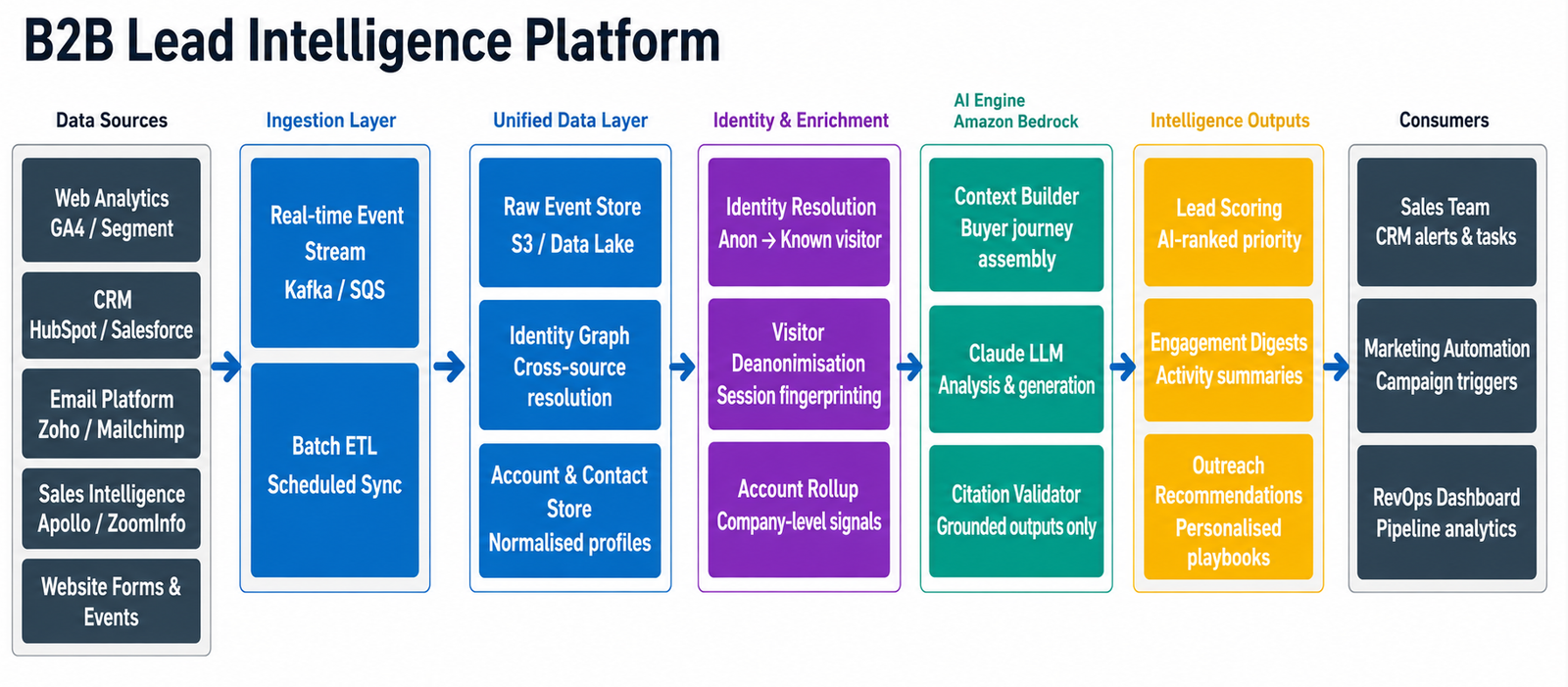
The platform is built in three layers, bottom-up. First, a unified data layer that connects to an organisation’s existing marketing and sales tools, bringing all engagement signals into one structured, timestamped store. Second, a lead identity resolution engine that matches anonymous activity to known contacts and rolls individual contacts up to account-level views. Third, Claude models orchestrated through Amazon Bedrock that generate actionable intelligence: engagement digests, outreach recommendations, and lead scoring, each grounded with explicit source citations.
The architectural principle is non-negotiable: identity is resolved before the AI layer runs. Every recommendation the AI generates must cite specific engagement data. A post-processing validation step verifies that every cited data point actually exists. If a citation cannot be verified, the recommendation is flagged and withheld.
Outcomes Achieved
Validated business value
- Unified engagement signals across marketing and sales platforms to reveal buying intent that no individual tool surfaced independently. Improved outreach timing and relevance through scored lead recommendations with actionable context
Product validation
- Validated the lead identity resolution model, successfully connecting anonymous web activity, email engagement, and account intelligence into unified buyer journeys. Validated grounded AI recommendations using Claude models via Amazon Bedrock, with built-in hallucination detection blocking unsupported outputs before delivery.
Commercial validation
- Delivered enterprise-grade lead intelligence at mid-market pricing, validating a viable alternative to platforms costing $30,000 to $120,000+ per year.
Frequently Asked Questions
How does the platform handle different combinations of marketing and sales tools?
The identity resolution engine is tool-agnostic. It works with whatever combination of web analytics, email marketing, sales intelligence, and CRM platforms an organisation already uses. The matching chain is based on deterministic signals (email addresses, tracking parameters, domain rollups) rather than vendor-specific APIs, so it adapts to the stack rather than requiring a specific set of tools.
How does the grounding mechanism prevent AI hallucinations?
Every factual claim the AI generates must cite a specific data point: a page view, an email click, a form submission, or an account signal. A post-processing validation step checks that every cited event actually exists in the database. If a citation cannot be verified, the recommendation is flagged and withheld. During testing, this mechanism caught and blocked AI-generated claims before they reached a user.
What is the realistic cost for a mid-market firm to operate this platform?
The platform runs on AWS Bedrock and managed PostgreSQL, with operating costs validated at a fraction of enterprise customer data platform pricing. The architecture was designed to make enterprise-grade lead intelligence accessible to mid-market B2B services firms.
At A Glance
Industry
Stage
Category
Stack
Sources
GenAI
Pilot
B2B Lead Intelligence
PostgreSQL 16, AWS Bedrock (Claude)
GA4, Zoho, Apollo, WordPress CF7