

Engineering Digital
Transformation with
Intelligence
We transform businesses through software innovation and intelligent systems. We enable digital transformation by combining deep engineering capabilities with a strong understanding of business, operational, and industry-specific realities.
Medical Devices / M&A
Four applications on the new company stack by Day 1. Monitored, verified, 22 days ahead of deadline.
Day 1
All four apps live and monitored
22 days
Ahead of contractual gate
0 P1s
During cutover
At A Glance
Industry
Platform
From
To
Context
Chemicals
Customer ordering, warranty, regulatory
infrastructure
Spring Boot 3.5, Java 21, AWS, Datadog
Multi-billion-dollar corporate separation
TL;DR
A multi-billion-dollar division was separating from its parent company. Four customer-facing applications needed to run independently from Day 1: a customer portal, an order management system, a service and warranty portal, and a regulatory submission interface. Together, these applications supported customer ordering, warranty services, and regulatory interactions that could not be interrupted.
All four applications were rebuilt on Spring Boot 3.5 with Java 21 on AWS, boundary-tested against every shared parent service, and monitored via Datadog from the moment they went live. The application workstream completed on Day 78, 22 days ahead of the Day 100 contractual gate. Zero P1 incidents on Day 1.
A multi-billion-dollar division was separating from its parent company. From the close date, the new company needed four customer-facing applications running on its own infrastructure: a customer portal for order placement and tracking, an order management system, a service and warranty portal, and a regulatory submission interface. All four ran on the parent’s shared infrastructure, authenticated against the parent’s identity provider, and read data from the parent’s ERP. Together, these applications supported customer ordering, warranty services, and regulatory interactions that needed to continue uninterrupted from the first day of independence.
The Transition Service Agreement(TSA) window was 18 months. From Day 1 of separation, the new company needed independent customer-facing systems capable of operating without the parent company’s infrastructure, identity services, or ERP dependencies. Every month of delay extended reliance on the parent environment and increased stranded costs for both organisations.
The programme office and systems integrator handled ERP migration, network separation, and identity infrastructure. They needed a specialist team for one workstream: rebuilding the four customer-facing applications so they could stand independently from Day 1, with production monitoring confirming everything was healthy.
The Problem
Every one of those four applications depended on shared parent services: identity and single sign-on, ERP master data (customer records, pricing, product catalogues), and network connectivity. These dependencies were undocumented; “the network just works” was the operating assumption until it had to be replicated independently.
“The separation deadline is not a target. It is a contractual commitment. Every deliverable is sized against that date.”
Why this was hard
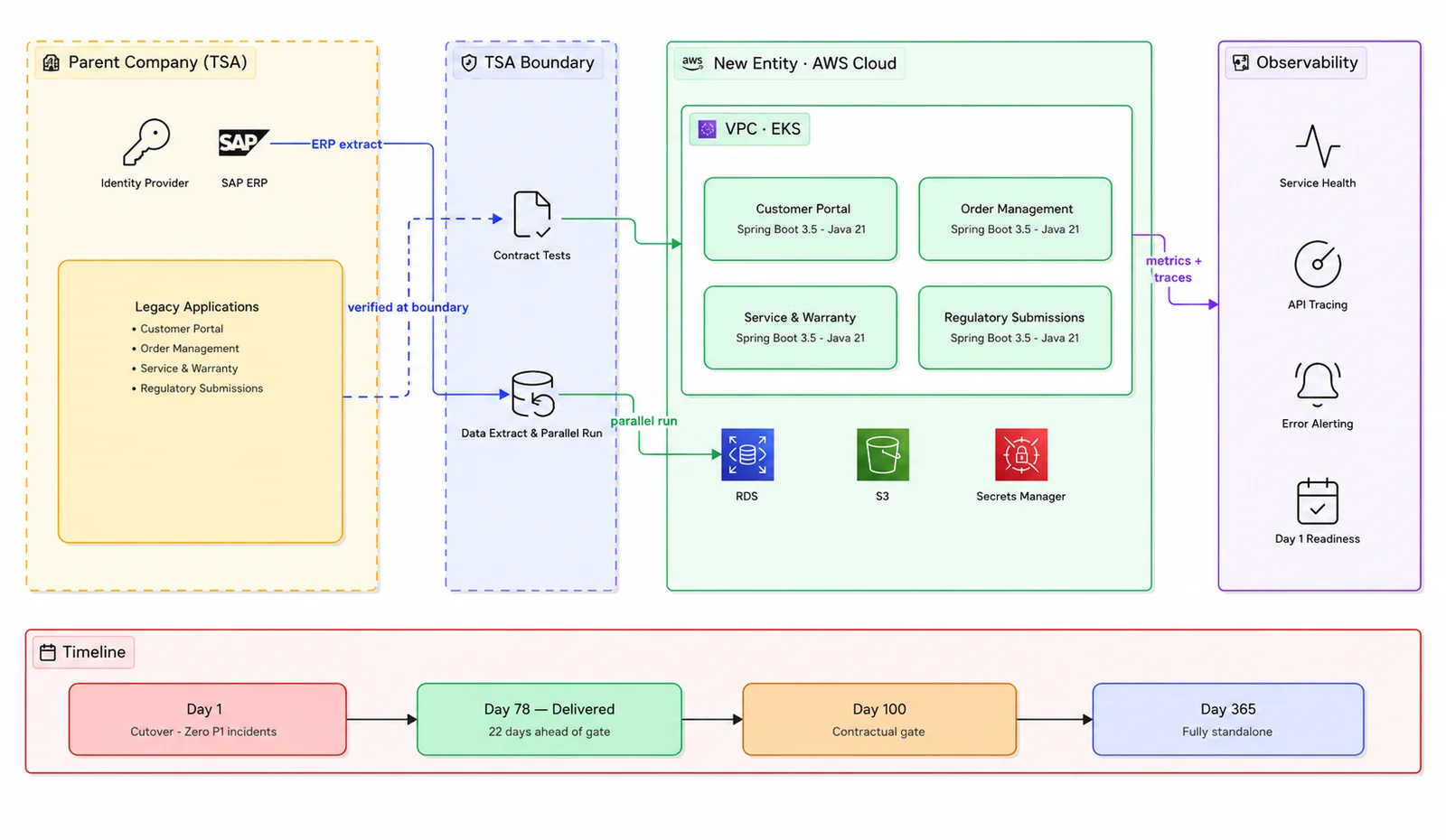
The parent’s ERP team, needed for data extracts, was unresponsive for two weeks mid-engagement because they were supporting the parent’s own system cutover. This delayed the parallel run start by 10 days. The team recovered by shortening the parallel run from 14 to 8 days while maintaining data accuracy validation above 99.5%.
The Approach
Every shared parent service was documented and wrapped in automated contract tests that could be re-pointed from the parent’s endpoint to the new entity’s replacement at cutover. The separation boundary became a monitored, replaceable interface.
Customer data was extracted from the parent’s ERP, loaded into the new entity’s system, and validated in a parallel run before Day 1. For each application, the decision between “build fresh” or “move and improve” was based on whether it could realistically ship within the TSA window, not on architectural preference.
Monitoring was a first-class deliverable: Datadog deployed across all four applications with service health dashboards, API response time tracking, error rate alerting, and a “Day 1 readiness” view. On Day 1, the monitoring dashboard was the primary evidence that all services were healthy. Runbooks were documented for the client’s operations team.
Outcomes Achieved
Operational readiness
- Four applications live and monitored from Day 1. Zero P1 incidents during cutover.
Programme impact
- Completed 22 days ahead of the contractual gate. Reduced TSA exposure for both organisations.
Sustainable operations
- Monitoring, alerting, and runbooks delivered as part of the application workstream. Boundary-testing pattern adopted across the remaining application estate.
Frequently Asked Questions
How does the boundary-testing approach work during a corporate separation?
Every shared parent service the applications depend on is documented and wrapped in automated contract tests. These tests run against the parent’s services during the TSA period and against the new entity’s replacement services post-separation. The swap from parent to replacement is a configuration change (endpoint URL), not a code change. The contract tests confirm behavioural parity.
What happens if an application is not ready by Day 1?
The Transition Service Agreement is the fallback. If an application is not ready, it continues running on the parent’s infrastructure under the TSA. This is what the TSA is designed for. The Day 1 go/no-go criteria (contract tests passing, parallel run accuracy above 99.5%, monitoring all-green) determine readiness. The decision is made by the new entity’s leadership.
Why is production monitoring delivered as part of the application workstream rather than separately?
Because Day 1 readiness is a monitoring question, not just a deployment question. The “Day 1 readiness view” dashboard is the primary evidence that all services are healthy. If monitoring is a separate project that runs after the application delivery, the first question the CIO asks on Day 1 cannot be answered.
At A Glance
Industry
Platform
From
To
Context
Medical Devices /
Chemicals
Customer ordering, warranty, regulatory
Shared parent
infrastructure
Spring Boot 3.5, Java 21, AWS, Datadog
Multi-billion-dollar corporate separation