
Engineering Digital
Transformation with
Intelligence
We transform businesses through software innovation and intelligent systems. We enable digital transformation by combining deep engineering capabilities with a strong understanding of business, operational, and industry-specific realities.
What GitHub Copilot, Amazon Q, OpenRewrite, watsonx Code Assistant, and Claude Code actually deliver
28 April 2026.
Reading Time: 5 Minutes.
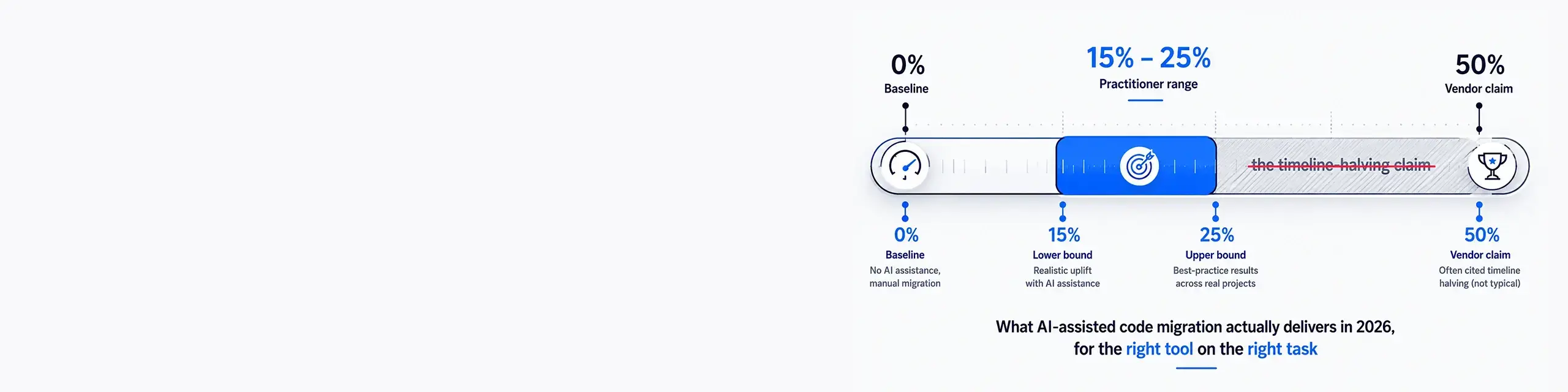
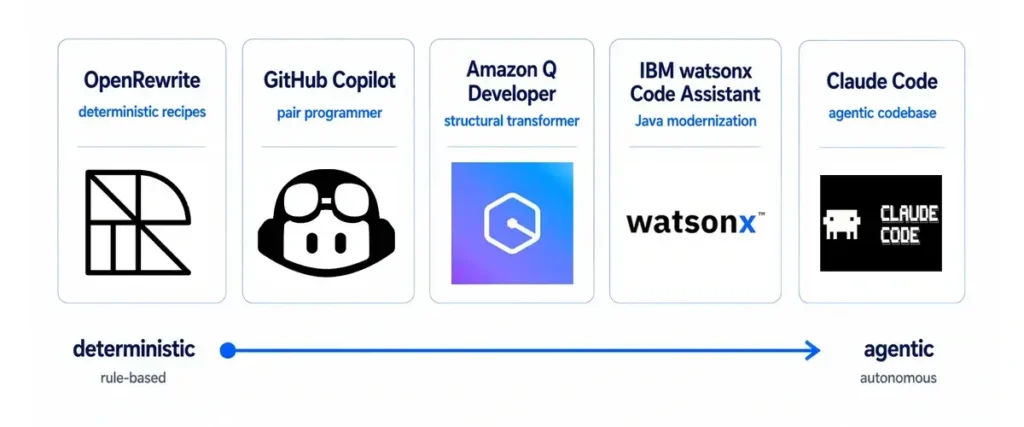
AI-assisted tooling has changed code migration economics by roughly 15 to 25 percent for the right tool on the right task. It has not halved migration timelines. Five tools dominate the 2026 landscape and each does different work:
1)OpenRewrite for deterministic recipe transformations,
2)GitHub Copilot for pattern-rich pair programming,
3) Amazon Q Developer for structural Java upgrades,
4)IBM watsonx Code Assistant for Java application modernization, and
5)Claude Code for agentic codebase-level migration.
None replaces the engineering judgement that picks the target architecture and validates behaviour after cutover.
AI-assisted code migration has moved from category-creation to category-execution. By 2026 the practical question for engineering leaders is no longer whether the tooling helps, but which combination of tools fits which migration, and what the team still has to provide for any of it to land in production. The honest read on delivery economics: roughly 15 to 25 percent acceleration for the right tool on the right task, not the timeline-halving the early years suggested.
Five tools dominate the practitioner-grade landscape. Each does different work and stops at different points. The walkthrough below covers what each actually delivers, where each stops, and what the engineering function still has to provide.
What does OpenRewrite actually deliver?
OpenRewrite is the most under-discussed and arguably highest-leverage tool in this landscape. It runs as a deterministic transformation engine driven by recipes, written and curated by the framework authors themselves, applied across a codebase to produce predictable, reviewable diffs. The same input always produces the same change set.
Recipe coverage is strongest in the Java ecosystem:
- Spring Boot 2 to 3 / 3.x / 4.0 transitions with full Jakarta namespace handling
- Java 11 / 17 / 21 / 25 LTS version upgrades
- The dedicated rewrite-liberty recipe set for WebSphere traditional to Liberty migrations
- JavaScript and TypeScript recipes that shipped in 2025 with a growing library
Apache 2.0 licensed, runs in Maven and Gradle pipelines, composes well with CI for batch migration of large codebases.
What does GitHub Copilot actually deliver?
GitHub Copilot is broadly deployed and understood by now. As pattern-based code completion integrated into VS Code, JetBrains IDEs, and Visual Studio, it has the lowest activation energy of any tool here. Most engineering teams already have it.
For migration work, Copilot is strongest on per-file pattern translation where source and target patterns are well-represented in its training corpus:
- Spring annotation translation
- Jakarta namespace updates
- React class-to-function refactors
- AngularJS controller-to-component conversion
The accelerator lands at 30 to 40 percent on well-conventional codebases for the pattern-recognition parts of migration work. On heavily customized codebases the acceleration falls below 15 percent. Codebase-wide reasoning is weak in baseline configurations; Spring auto-configuration and transaction semantics need manual attention.
What does Amazon Q Developer actually deliver?
Amazon Q Developer is AWS’s structural migration tool for Java, available in IDE and through the AWS Transform web experience. Its Java upgrade capability covers Java 8 / 11 / 17 / 21 source projects targeting Java 17 or 21.
Published AWS research reports approximately 40 percent acceleration of Java migration effort, with an 85 percent higher success rate after enhanced debugger improvements on 62 large open-source applications. These are vendor figures: directionally credible, worth verifying against your codebase before relying on them.
Practical limits worth knowing before scoping:
- Build time: projects must build within 55 minutes.
- Network access: no private-network access during build.
- Build complexity: complex build configurations or non-standard project structures need manual setup
What does IBM watsonx Code Assistant actually deliver?
IBM watsonx Code Assistant for Enterprise Java Applications (WCA4EJA) is IBM’s consolidated Java modernization tool. Through 2025 IBM retired its older modernization products, including Mono2Micro and Cloud Transformation Advisor, and folded their capabilities into the watsonx Code Assistant family. The result is one tool covering analysis, planning, and execution across the Java modernization journey:
- WebSphere traditional to Liberty: prescriptive plan with complexity and effort assessment, automated code and configuration changes where possible, generative-AI assistance for complex refactorings.
- Monolith to microservices: inherited decomposition logic suggests service boundaries from static and dynamic call-graph analysis, then helps generate the Liberty microservices that result
- Java version upgrades: covers the LTS-to-LTS uplift path with automated dependency reconciliation.
- Knowledge preservation: unit-test generation, code explanation, and documentation useful where institutional knowledge has thinned.
Java and COBOL only: JavaScript frameworks, Python, and other non-JVM stacks are out of scope.
What does Claude Code actually deliver?
Claude Code operates in a category distinct from the others. Where OpenRewrite runs deterministic recipes and Copilot completes patterns, Claude Code operates as an agent: it reads codebases up to one million tokens of context, plans changes across multiple files, writes the code, runs tests, reads error output, and iterates. Generally available since early 2025, it is now powered by Claude Opus 4.7 and scores 87.6 percent on SWE-bench Verified, up from 80.8 percent on the predecessor model. The benchmark caveat matters: SWE-bench Verified has known training-data contamination issues across all frontier models, and Scale AI’s SWE-bench Pro (designed to be contamination-resistant) shows the same generation of models in the 56 to 64 percent range, which is the more honest read on current agentic capability.
Anthropic positions Claude Code around five capability areas:
- Legacy analysis with dependency graphs and complexity-based prioritisation.
- Systematic transformation that preserves business logic across multi-file refactors
- Automated test generation scoped to the changes the agent has made.
- Security and compliance updates that preserve regulatory patterns embedded in legacy code.
- Documentation generation from undocumented code, useful where institutional knowledge has thinned.
Architectural decisions still sit with the engineering function; agentic output without review discipline produces preventable failures.
| Tool | Category | Strongest at | Weakest at | License | Best-fit scenarios |
| OpenRewrite | Deterministic recipe engine | Spring Boot 2 to 3 / 4, Jakarta, Java LTS uplifts, WebSphere to Liberty | Novel migrations with no recipes, JS / TS less mature | Open source, Apache 2.0 | Spring Boot 2 to 3 / 4, Java EE to Modern Java, in-place Java uplift |
| GitHub Copilot | Pattern-based pair programmer | Per-file pattern translation, refactoring help, idiom translation | Limited codebase-wide reasoning, weak on auto-configuration | Commercial SaaS, per-seat | Manual-cleanup acceleration alongside other tools, frontend refactors |
| Amazon Q Developer | Structural Java transformer | Java 8-21 to 17 or 21 uplift with 40% reported acceleration | 55-min build limit, no private network during build, complex builds need setup | Commercial SaaS, AWS subscription | In-place Java version uplift on AWS-bound workloads |
| IBM watsonx (WCA4EJA) | IBM Java modernization suite | WebSphere to Liberty plans, monolith decomposition, Java upgrades | Java and COBOL only, decomposition needs engineering validation | Commercial SaaS, Resource Unit pricing | WebSphere to Liberty, Java EE to Spring Boot, monolith to microservices |
| Claude Code | Agentic codebase-level transformer | Whole-codebase context to 1M tokens, multi-file refactoring, test generation, language-agnostic | Architectural decisions still human, output needs review discipline, prompt practice matters | Commercial SaaS, usage-based | PowerBuilder to modern stack, AngularJS to Angular / React, COBOL, any agentic refactor |
What does the tooling not do?
A piece on what AI-assisted tooling delivers should end with what it does not. Three categories of work remain entirely the responsibility of the engineering function, regardless of which combination of these five tools is in play.
- Test coverage that proves behavioural equivalence. All five tools can generate tests. None can verify the generated tests cover the behaviour the business actually depends on. Characterisation tests against current behaviour, critical end-to-end paths, contract tests at integration points: the tooling accelerates the writing, it does not decide which behaviour to prove.
- Architectural decisions about target stacks and boundaries. Whether to migrate Spring Boot 2 in place to 3 or to skip to 4, whether to keep a modular monolith or decompose, whether to port AngularJS to Angular 17+ or to React, whether to consolidate over-decomposed microservices: these decisions sit with the engineering function. Tooling executes them; it does not make them.
- Operational handover. Migration delivery ends at production cutover. Runbook updates, monitoring and alerting changes, on-call rotations adjusted for the new architecture: none of this is in scope for any of the five tools discussed here. Teams that treat operational handover as an afterthought spend the productivity gain back within the first quarter of running the modernized system.
Frequently Asked Questions
Why 15 to 25 percent and not the 40 to 50 percent?
Figures typically isolate the steps where the tools delivers the most lift (a Java version upgrade run end-to-end with all dependencies green, an AngularJS-to-Angular refactor on a well-conventional codebase), then quote the acceleration on that subset.
The practitioner-grade 15 to 25 percent figure is end-to-end across a full migration programme, including the work the tooling does not accelerate: characterisation testing, architecture decisions, operational handover. Both numbers can be true at the same time. Plan against the lower one for budget and timeline; the upper one is the upside if everything goes right.
Can one of these five tools replace the others?
No. Each does work the others cannot. OpenRewrite runs deterministic recipes; Copilot completes patterns; Amazon Q does structural Java upgrades; IBM watsonx handles WebSphere to Liberty and Java monolith decomposition; Claude Code operates agentically across whole codebases. The combinations that work well in practice typically pair a deterministic recipe engine (OpenRewrite) with an agentic tool for the remaining edge cases (Claude Code) and an IDE pair programmer for the manual cleanup (Copilot or Amazon Q). Picking only one tool means leaving acceleration on the table for the work that tool does not do well.
How do SWE-bench benchmark scores translate to real migration outcomes?
Loosely. SWE-bench Verified scores have known training-data contamination issues across all frontier models, and SWE-bench Pro (contamination-resistant) shows the same models in the 56 to 64 percent range rather than the 85 to 94 percent range. A high benchmark score is necessary but not sufficient for production-grade migration work. The benchmark tests bug-fix-in-isolation; migration work tests architectural reasoning, test-coverage discipline, and behavioural equivalence validation, none of which the benchmark measures. Use benchmark scores as one signal among several, not as the deciding factor.