
Engineering Digital
Transformation with
Intelligence
We transform businesses through software innovation and intelligent systems. We enable digital transformation by combining deep engineering capabilities with a strong understanding of business, operational, and industry-specific realities.
Beyond “Rip and Replace”: The 6R Framework for Surgical Modernization
26 April 2026.
Reading Time: 4 Minutes
Modernization isn’t a software problem. It’s a systems engineering problem. The 6R Framework (Retain, Retire, Rehost, Replatform, Refactor, Rebuild) categorizes every service in your legacy stack by business outcome not technical preference letting you move past the false choice between Big Bang rewrite and indefinite patching.
By mid-2026, the software industry has reached a collective realization: the move-fast-and-break-things era of early AI adoption has left behind fragmented systems and fragile integrations. For the CTO and VP of Engineering, modernization is no longer a future-quarter consideration. It is a tactical requirement.
But the path is littered with the remains of Big Bang migrations — projects that promised a cloud-native rebirth and delivered three years of downtime, millions in overages, and zero business value. 88% of business transformations fail to achieve their original ambitions.
The fear of these failures leads to the opposite danger: paralysis!
Many organizations keep patching 2018 monoliths because the alternative feels like open-heart surgery in a dark room.
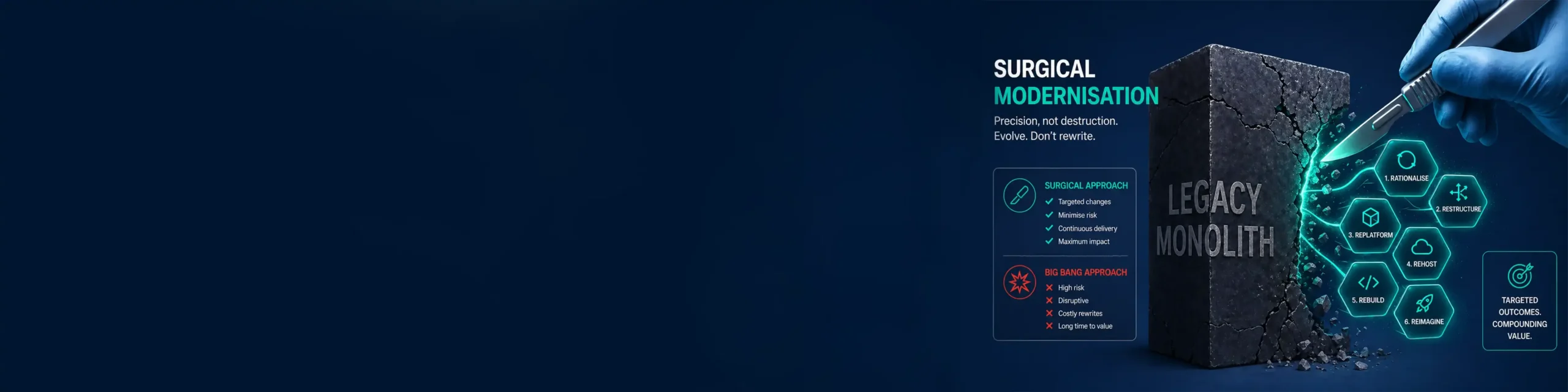
At Cogentis, we believe there’s a third path. It begins with changing how we define the problem. Modernization is not a software problem. It is a systems engineering problem one that follows the principle of understand first, build second.
Why the "software-only" lens fails
The trap of the "Universal Hammer"
The most common mistake in modernization is deciding everything must be moved to microservices, or everything must be serverless, regardless of the specific service.
Not every piece of your legacy stack is a liability. Some of your oldest code is your most stable battle-tested logic that has survived a decade of edge cases. Conversely, some of your newest 2024 AI wrappers may be your biggest bottlenecks.
A Universal Hammer approach is what drives project timelines into multi-year ranges. A surgical strategy requires a framework that categorizes each component and applies the specific treatment it deserves, balancing risk against business return.
The 6R Framework
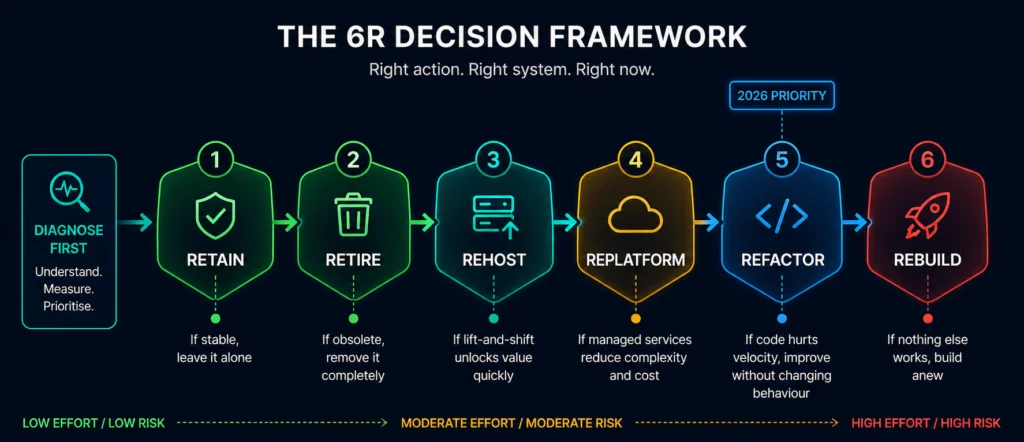
The 6R Framework is six paths (Retain, Retire, Rehost, Replatform, Refactor, Rebuild) applied to every service in a legacy stack based on business outcome, not technical preference.
| R | When to Use | Complexity | Cost | Risk | AI-Readiness Impact |
|---|---|---|---|---|---|
| Retain | Stable, value-delivering modules that are not bottlenecks | None | None | None | Neutral |
| Retire | Dead features, dormant integrations, abandoned experiments | Low | Saves cost | Low | Neutral — reduces security and testing surface |
| Rehost | Aging data center exit; lift-and-shift to cloud | Low | Low | Low | Low — environment change only |
| Replatform | Self-managed services moved to managed equivalents | Medium | Medium | Low | Medium — operational debt eliminated |
| Refactor | Bottlenecks throttling autonomous agent performance | High | High | Medium | High — closes the AI Execution Gap |
| Rebuild | Brittle code or obsolete language where refactor cost exceeds rebuild cost | Highest | Highest | High | High — reserved for narrow, isolated cases |
- Retain — the strategic status quo
If a module is stable, delivers its intended value, and does not bottleneck your AI agents or GTM velocity, leave it alone. Engineering bandwidth is finite. Save it for the friction points. - Retire — eliminating dead weight
Legacy monoliths typically carry meaningful dead weight unused features, dormant integrations, abandoned experiments. Retiring these reduces your security surface area, simplifies testing, and lowers cloud cost. The fastest win in most modernization engagements is retiring before refactoring. - Rehost — the infrastructure shift
Sometimes the problem isn’t the code; it’s the environment. Rehosting (lift-and-shift) moves applications to cloud infrastructure without changing core code. This won’t solve the deeper Invisible Tax, but it’s a quick win for exiting aging data centers. If you haven’t done this yet, it’s usually the first move. - Replatform — lift and reshape
Keep the core logic but move it to a modern managed service. A self-managed legacy database moves to Amazon RDS, Azure SQL, or Cloud SQL. You gain auto-scaling and managed backups with minimal code changes. Eliminates a specific category of operational debt without a full refactor. - Refactor — engineering for agility
This is the core of 2026 modernization. The architecture is reorganized to leverage cloud-native features typically moving from monolithic to event-driven. This is essential for closing the AI Execution Gap, because it allows agents to trigger services independently and asynchronously. - Rebuild — the last resort
Only recommended when existing code is so brittle, or the language is so obsolete, that the cost of refactoring exceeds the cost of a fresh start. Because the other five Rs are applied elsewhere, a rebuild is no longer a three-year Big Bang. It becomes a scoped, isolated task.
What vendor bias does to modernization
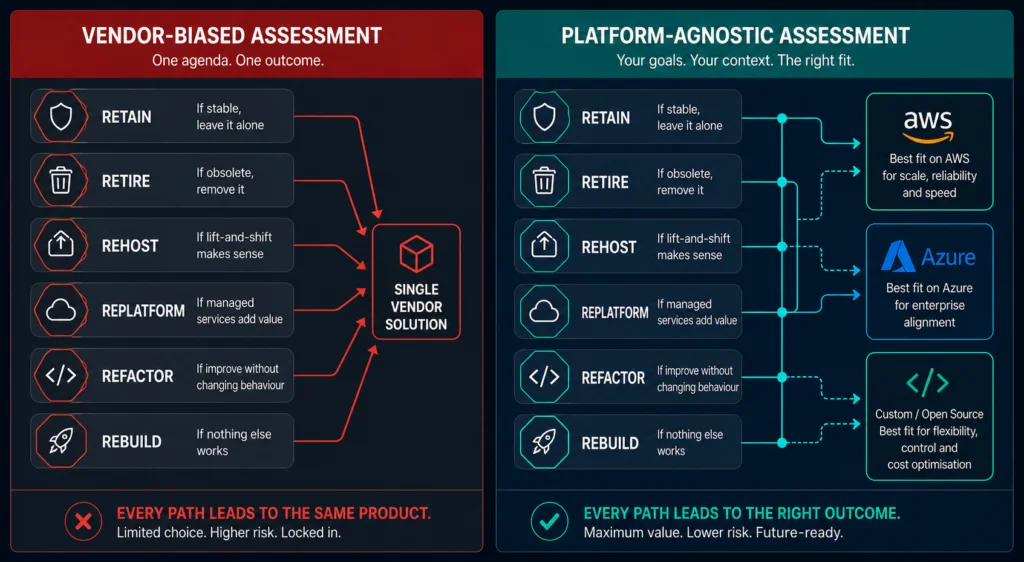
One of the primary reasons modernization projects fail is vendor bias. Many consulting firms are incentivized to push you toward a specific platform because of partnership quotas or reseller commissions. If they’re a Gold Partner for a specific vendor, their 6R assessment will miraculously find that every “R” leads to that vendor’s most expensive services.
At Cogentis, we are platform-agnostic by design. We have no partnership quotas to hit. If your agents run best on AWS Lambda, that’s where we build. If your data residency requirements favor Azure, we optimize there. Our loyalty is to the structural integrity of your system not to a vendor’s license revenue.
This independence is what makes the 6R categorization honest.
What reclaiming the Velocity Dividend looks like
Organizations following this practitioner-led, systems engineering approach typically report 30–40% effort reduction vs. unguided migrations.
More importantly, by retiring dead weight and refactoring the right bottlenecks, you reclaim the 25–40% of engineering capacity currently lost to the Invisible Tax. Your senior developers move from Architectural Archaeology to building the multi-modal, agentic features your 2027 roadmap requires.
Modernization shouldn’t be a gamble. It should be a disciplined engineering exercise based on visibility, not guesswork. The 6R Framework starts with an Architecture Audit that looks at your systems not as a list of files, but as a system designed to deliver business outcomes
Frequently asked
What is the 6R Framework?
A practitioner-led methodology categorizing every service in a legacy stack into one of six paths: Retain, Retire, Rehost, Replatform, Refactor, or Rebuild. The categorization is based on business outcome not technical preference or vendor incentive.
Why not just do a full rewrite?
Because 88% of business transformations fail to achieve original ambitions. Big Bang rewrites feature-freeze the existing system while you rebuild what already works. The 6R approach avoids this by retaining stable code and refactoring only the bottlenecks.
How do you decide which R applies to each service?
By mapping the digital thread first — understanding where data flows, where AI agents are throttled, and where legacy code delivers stable business value. Decisions are based on measurable business impact, not technology preference. This is what the Architecture Audit produces.