
Engineering Digital
Transformation with
Intelligence
We transform businesses through software innovation and intelligent systems. We enable digital transformation by combining deep engineering capabilities with a strong understanding of business, operational, and industry-specific realities.
The AI Execution Gap: Why 2024’s Wrappers Can’t Power 2026’s Agents
25 April 2026.
Reading Time: 4 Minutes
In 2026, autonomous agents require high-fidelity data, event-driven architecture, and sub-second orchestration. Most enterprise stacks were designed for none of these. The result is the AI Execution Gap the distance between what your models can do and what your infrastructure lets them do. Teams bridging that gap with custom glue code are building a new form of technical debt: Spaghetti AI.
In the spring of 2024, AI felt easy. If you could connect an API key, a prompt wrapper, and a vector database, you had an “AI-powered” product. The board was satisfied. The market applauded.
Two years later, the game has fundamentally changed. The market has moved past chat-with-your-PDF. Today’s competitive edge belongs to Autonomous Agents systems that don’t just summarize data, but act on it, navigate your entire software ecosystem, and execute multi-step tasks across services with minimal human intervention.
The painful truth many CTOs are discovering: you can’t run a 2026 agentic workflow on a 2018 monolithic foundation.
What is the AI Execution Gap?
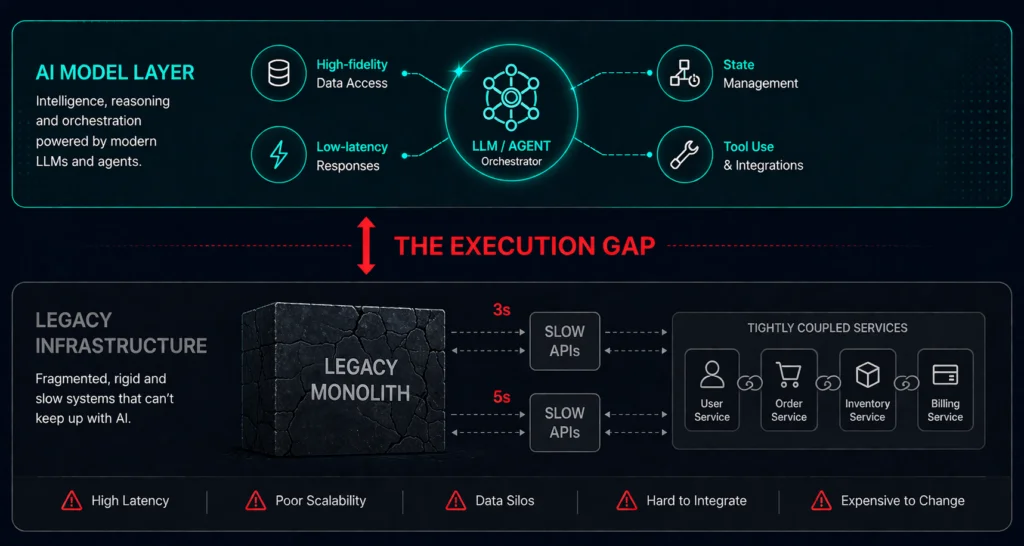
The AI Execution Gap is the distance between the intelligence of modern AI models and the rigidity of the infrastructure running them.
In 2024, AI was a side-car. You sent a query to an LLM, got a text response, displayed it in a UI. The digital thread of your application remained untouched.
In 2026, AI is the engine. Autonomous agents require deep, real-time integration into your core systems. To be effective, an agent needs:
- High-fidelity data access: Live production data, not stale vector embeddings.
- Low-latency orchestration: Function calls across services in milliseconds, not seconds.
- State management: Context maintained across long-running, multi-step processes.
- Tool use over prompt-stuffing The ability to pull data on demand rather than receive it all up front.
In a tightly coupled legacy environment, your agent is blind and bound. If a legacy service takes three seconds to return a user profile, and another five seconds to verify a transaction history, your agent’s decision loop is too slow to be useful.
What is Spaghetti AI?
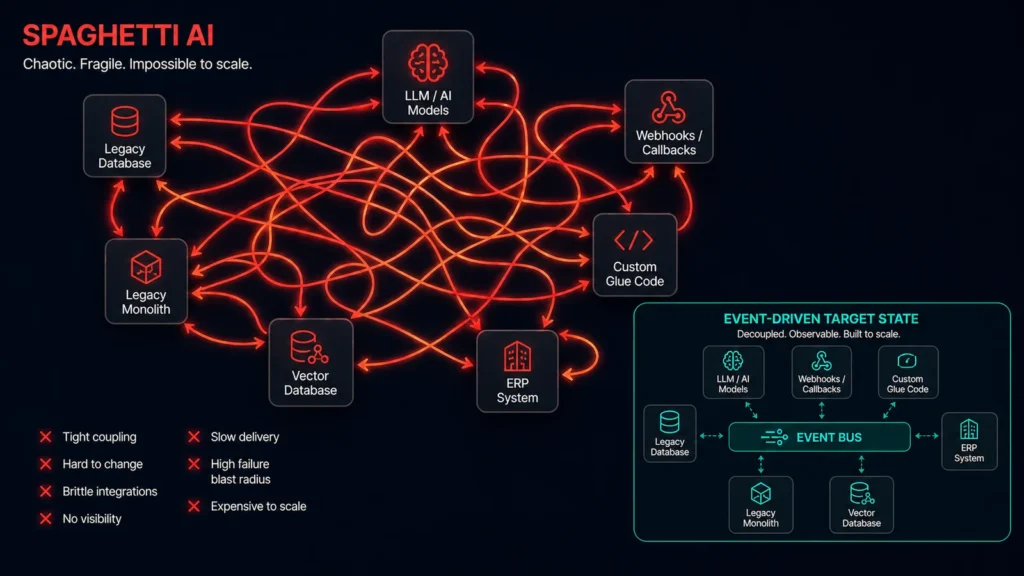
Spaghetti AI is the web of unmanaged point-to-point integrations that forms when legacy architecture can’t support modern agents.
When a team can’t route an agent cleanly through the stack, the natural instinct is to build bridges. Custom glue code connecting a specific LLM to a specific legacy database. Undocumented webhooks bypassing monolithic bottlenecks. Prompt-stuffing the entire context into every call because the tool-use layer was never built.
By mid-2026, teams who went this route have a web of integrations that is impossible to secure, nearly impossible to debug, and structurally fragile. Every model upgrade means untangling the web. Every agent pivot requires rewriting the glue.
This is the new Invisible Tax on AI investment. You are shipping features, but you are also shipping structural fragility that will eventually stall your SDLC.
Why is this worse than 2018-era tech debt?
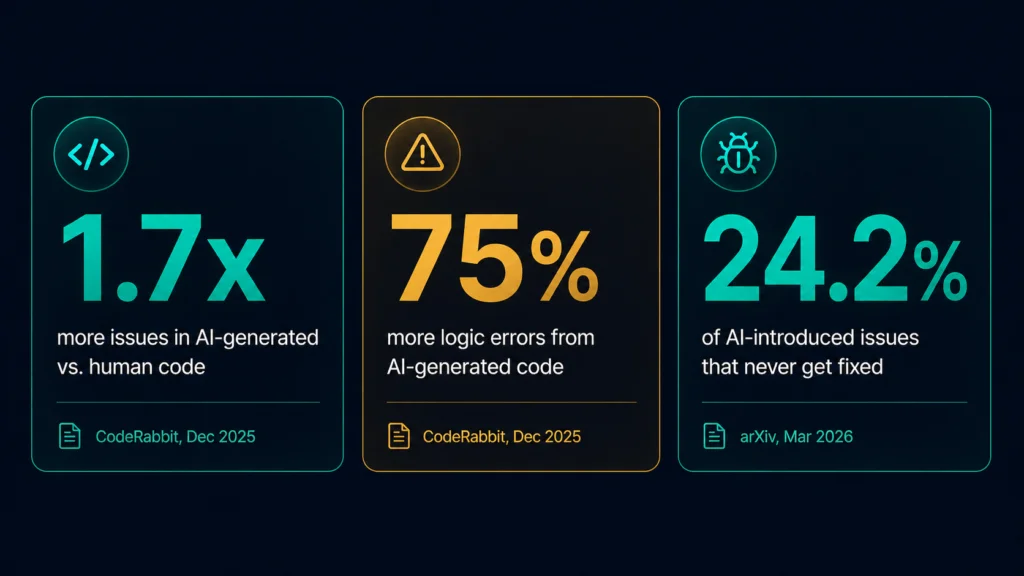
What CTOs and VPs of Engineering see in the data
For the Engineering Leader, this manifests as an unplanned work crisis. The team spends more time debugging why an agent hallucinated a database schema than building new agentic capability. Senior developers act as human middleware, manually correcting the failures of an inflexible system.
For the CTO, it is a margin problem. You are paying for top-tier compute and high-token-count models, but output is being throttled by a backend never designed for this level of throughput. You are paying Ferrari prices to drive through a parking lot.
How does systems engineering close the gap?
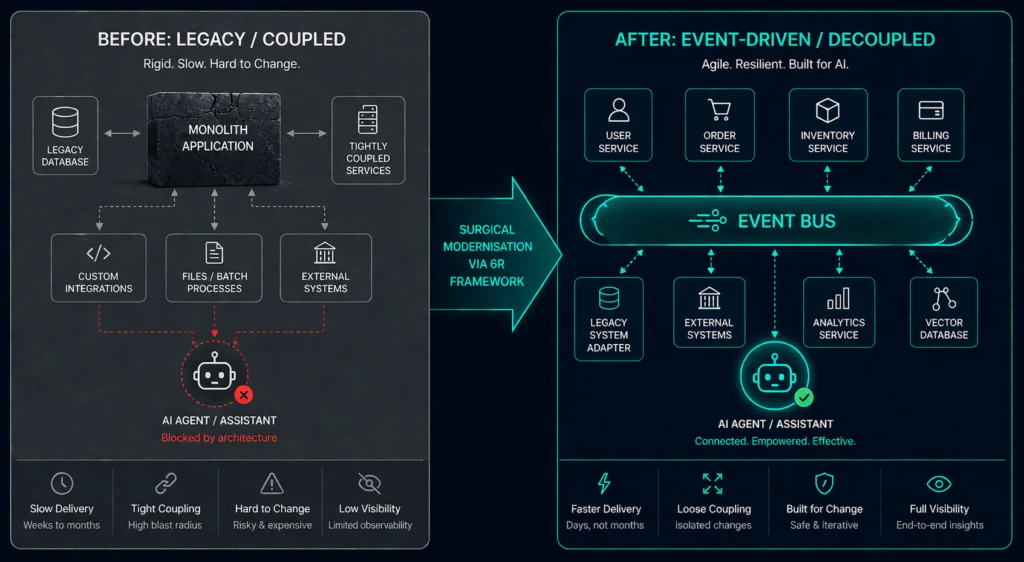
What you reclaim by closing the gap
The outcome is the Velocity Dividend — the engineering capacity reclaimed when structural drag is removed.
Organizations working with structured modernization approaches typically report 30–40% effort reduction vs. unguided migrations. More importantly, engineers stop untangling Spaghetti AI and start building the next generation of agentic features.
In 2026, “AI-powered” is no longer a differentiator. AI-agility is. Can your architecture support the next wave of intelligence, or is it acting as a ceiling?
Frequently Asked Questions
What is the AI Execution Gap?
The distance between the intelligence of modern AI models and the rigidity of the infrastructure running them. Agents need high-fidelity data, event-driven orchestration, and millisecond latency — most enterprise stacks provide none of these.
Can we keep patching with custom integrations?
Short-term yes, long-term no. This is how Spaghetti AI forms. AI-generated code already introduces 1.7x more issues than human-written code (CodeRabbit, December 2025); glue-code patterns multiply that debt.
Is the fix a rewrite?
No. The fix is surgical — refactor the bottlenecks that throttle agent performance, retain what works, retire what’s dormant. This is the 6R Framework applied to AI-readiness, starting with an Architecture Audit.