
Engineering Digital
Transformation with
Intelligence
We transform businesses through software innovation and intelligent systems. We enable digital transformation by combining deep engineering capabilities with a strong understanding of business, operational, and industry-specific realities.
The Architecture Audit: Six Signals the Invisible Tax Is Costing You Your 2027 Roadmap
26 April 2026.
Reading Time: 4 Minutes
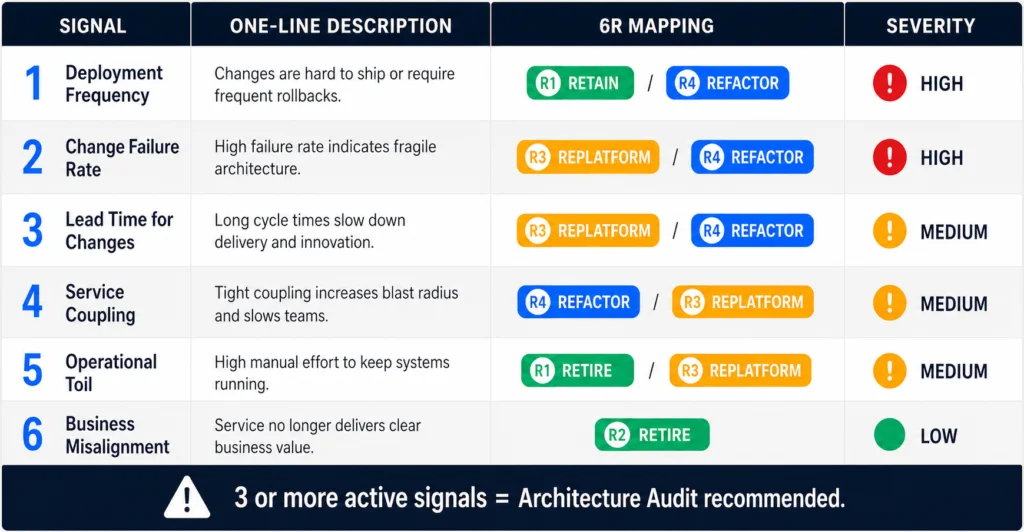
If three or more of these six signals are active in your engineering organization, you are paying the Invisible Tax and your 2027 roadmap is already compromised. A structured two-week Architecture Audit maps each signal to a specific fix within the 6R Framework. The reclaimed capacity the Velocity Dividend typically shows up in cycle time within one quarter of acting on the audit
Why diagnose before you modernize
Most modernization projects fail the same way: they start with a technology decision (“we’re moving to microservices,” “we’re going serverless”) before anyone maps where the actual bottlenecks are.88% of business transformations fail to achieve their original ambitions.
The cause is simple. Teams treat modernization as a software problem when it’s a systems engineering problem one that follows the principle of understand first, build second.
The Architecture Audit is a two-week, practitioner-led diagnostic that produces a prioritized modernization roadmap categorized against the 6R Framework. It does not commit you to any rip-and-replace project. It tells you where to spend your engineering bandwidth for maximum return and where to leave things alone.
The six signals — what we look for
Each signal below is observable from within your organization, usually in the data your team already has. Three or more active signals means the Invisible Tax is costing you measurable velocity. Here’s what we look for, and what each signal maps to in the 6R Framework.
Signal 1: Your senior engineers spend more than 30% of their week on Architectural Archaeology
Your architects hired to build 2026-grade capability are instead excavating 2018 code to keep new changes from breaking old systems. Engineering time lost to debt-related work can vary between 25–42% of total capacity. If your organization is in that range, the tax is real and the senior talent is the most expensive asset paying it.
Maps to: Refactor (the core 6R move) + Retire (kill the dormant modules senior engineers are maintaining for no business reason).
Signal 2: Deploy frequency has dropped while feature output hasn’t
Six months ago your team shipped 8 times a week. Now it’s 4. The team is the same, the feature backlog is the same, but the cadence has slowed. This usually means larger batch sizes per deploy which DORA’s 2025 research confirms is the dominant failure pattern in AI-accelerated teams. You’re shipping more code through the same constrained pipeline, and each release carries more risk.
Maps to: Refactor (the CI/CD and deployment layer) + Replatform (if the bottleneck is in a self-managed database or middleware).
Signal 3: Your rollback rate has doubled in six months
Two percent of deploys require rollback, up from 0.5%. The failing features work fine in staging. This is environment divergence staging no longer represents production, and it’s the leading indicator of accumulating architectural incoherence. It’s also the signal that tells us observability and environmental parity are underinvested.
Maps to: Refactor (observability) + Replatform (environment orchestration).
Signal 4: Cross-team dependencies require relationship management, not APIs
Shipping a feature that touches two systems requires Slack threads, coordination meetings, and personal favors rather than well-documented service contracts. This is almost always a sign the application is still effectively monolithic, even if it’s been partially decomposed. The boundaries are formal but the coupling is real.
Maps to: Refactor (move to event-driven, contract-tested architecture) + possibly Rebuild for isolated services where the coupling is unfixable.
Signal 5: AI agents hit performance walls that the models themselves aren’t causing
You’re paying for top-tier compute and current-generation models, but agent response times are slow. The model isn’t the problem — the backend is. This is the AI Execution Gap showing up in latency data: a legacy service takes three seconds to return a user profile, and another five seconds to verify transaction history, and your agent’s decision loop is too slow to be useful.
Maps to: Refactor (decouple the services the agent needs to query) + Retire (strip out legacy code paths the agent never uses but has to route around).
Signal 6: Your engineers are writing “glue code” and point-to-point AI integrations that nobody documents
This is Spaghetti AI. When the architecture can’t support modern agents, the team builds custom bridges webhooks, inline prompts, hardcoded integrations because they work in the short term. Over time, these become a web that’s impossible to secure, debug, or scale. CodeRabbit’s December 2025 analysis shows AI-generated code already introduces 1.7x more issues than human-written code; the arXiv study on AI code debt shows 24.2% of those issues survive at HEAD permanently. Layer Spaghetti AI on top of that and you have compounding debt.
Maps to: Refactor (build the tool-use layer and event mesh Spaghetti AI is substituting for) + Retire (kill the undocumented bridges).
What a 4 week Architecture Audit produces
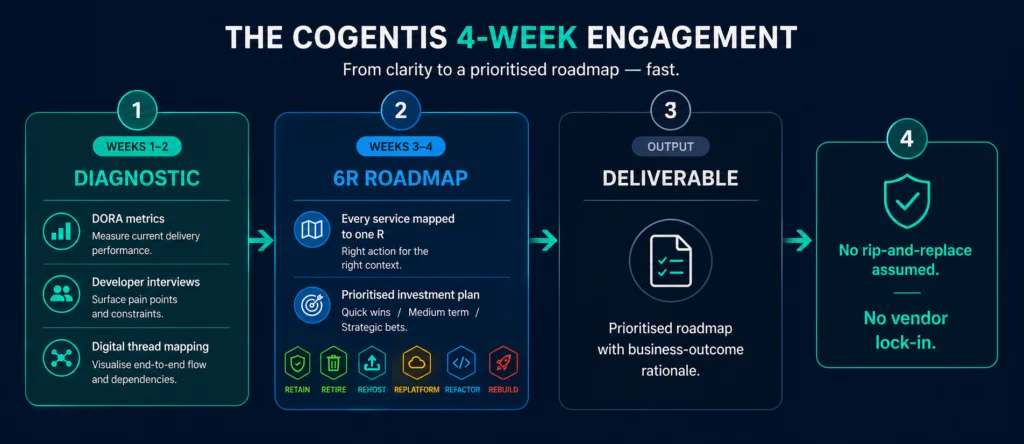
Week 1 and 2 — Diagnostic. Delivery metrics based on DORA benchmarks. Developer experience interviews across engineering levels. System architecture review mapping the digital thread. The goal: identify which signals are active and measure their severity quantitatively where possible.
Week 3 and 4 — 6R roadmap. Every service mapped to one of the six Rs based on business outcomes. Prioritized investment plan with quick wins (2–4 weeks, tooling changes), medium-term investments (1–2 quarters, architecture changes), and strategic bets (2–4 quarters, platform buildout). Each recommendation includes expected impact on cycle time, deploy frequency, or developer experience.
Output: a concrete plan that answers where do we start, not just what’s wrong. No vendor lock-in assumed. No rip-and-replace implied.
The Velocity Dividend — what you reclaim
Organizations acting on a structured, practitioner-led diagnostic typically report 30–40% effort reduction vs. unguided migrations.
More importantly, the 25–40% of capacity currently lost to Architectural Archaeology gets reclaimed. In our experience, engineers spend more than 50% of their time paying the tech debt tax can expect it to go down to 25% after restructuring how debt was managed.
This is the Velocity Dividend — the engineering capacity reclaimed when structural drag is removed. In practice it shows up as:
- Deployments become non-events - automated CI/CD and observability mean shipping is no longer a high-stakes gamble.
- Agents have eyes and hands - decoupled services, clean data threads, millisecond orchestration.
- Scalability is elastic - 10x traffic spikes handled without manual intervention.
- Senior engineers stop leaving - the work becomes building, not excavating
Why platform independence matters for the dividend
A critical but underdiscussed element: platform independence is what keeps the Velocity Dividend in your pocket. If modernization was driven by a consultant incentivized to sell you a specific cloud’s proprietary services, you may have traded one form of debt for another. When that vendor raises prices or sunsets a service, your velocity hits a new wall.
Cogentis is platform-agnostic by design. No partnership quotas. We select tools that provide the most flexibility for your environment AWS, Azure, GCP, OCI, or hybrid. Loyalty is to your architecture, not a vendor’s license revenue.
What happens after the audit
Most teams act on the quick wins in the first 30 days retiring dead modules, implementing observability on the highest-traffic services, wiring automated deployment gates. Medium-term work takes 1–2 quarters. Strategic work takes 2–4.
None of it is Big Bang.
Every phase delivers its own increment of the Velocity Dividend.
Frequently Asked Questions
What is the Architecture Audit?
A two-week, practitioner-led diagnostic that benchmarks your engineering organization against DORA data, interviews developers across levels, maps the digital thread of your architecture, and produces a prioritized modernization roadmap categorized against the 6R Framework.
How is it different from an internal tech debt review?
Internal reviews typically focus on code-level issues and depend on tribal knowledge. The Architecture Audit treats modernization as a systems engineering problem mapping where the Invisible Tax is actually paid, grounded in DORA benchmarks, and outputs a business-outcome-driven roadmap rather than a code-quality report.
Does the audit require committing to a larger engagement?
No. The audit is scoped as a standalone 4-week diagnostic. The output is yours you can act on it internally, bring in a different partner, or engage us for the modernization work. Our loyalty is to your architecture, not to locking you into a multi-quarter engagement