

Engineering Digital
Transformation with
Intelligence
We transform businesses through software innovation and intelligent systems. We enable digital transformation by combining deep engineering capabilities with a strong understanding of business, operational, and industry-specific realities.
The React + TypeScript Scale Wall: Your Second Rewrite Won’t Save You
28 April 2026.
Reading Time: 4 Minutes.
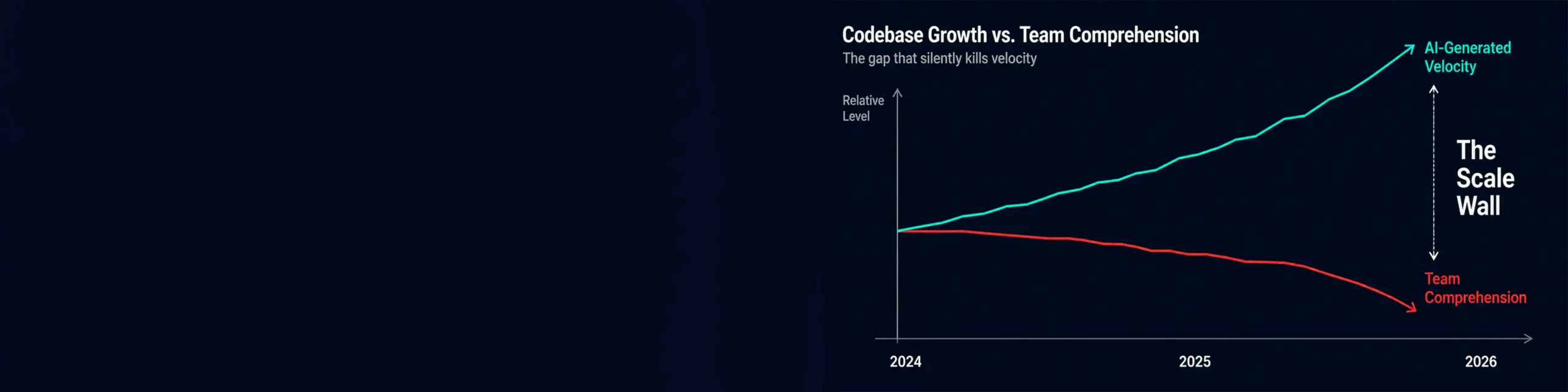
The React + TypeScript scale wall of 2026 is fundamentally different from 2024’s. The old bottleneck was infrastructure. The new one is comprehension the gap between the code AI generates at unprecedented speed and the architectural understanding needed to maintain it. The instinct to fix this with a rewrite won’t work. Architectural guardrails will
Your team has never shipped faster. Copilot and Cursor are autocompleting components before the ticket is groomed. An engineer who joined three weeks ago has pushed fourteen pull requests. 41% of all committed code is now AI-assisted.
And yet something is off. The codebase is growing faster than anyone can comprehend it. Three teams are importing from the same shared hook each assuming a different contract. Your most experienced engineer just spent a full sprint debugging a data-fetching layer that Cursor scaffolded, because nobody on the team fully understood how it handled error boundaries and retry logic.
This is the React + TypeScript scale wall of 2026. It is a tactical instance of the AI Execution Gap playing out in the frontend and the fix follows the same pattern: governance first, not rewrite.
The speed-comprehension tradeoff
Why React + TypeScript hit this hardest
React is unopinionated by design. It doesn’t enforce a state management pattern, a data-fetching convention, a folder structure, or a module boundary model. When a senior engineer writes React, those decisions are implicit. When an AI assistant writes React, it produces locally correct, globally incoherent output. Each component works. The composition doesn’t.
TypeScript compounds the issue. Strong typing should constrain AI output — and when strictly configured, it does. But in codebases where TypeScript strictness was adopted incrementally (which describes most production applications), AI assistants exploit the gaps. They generate any-typed escape hatches. They create utility types that satisfy the compiler but obscure the actual data contracts.
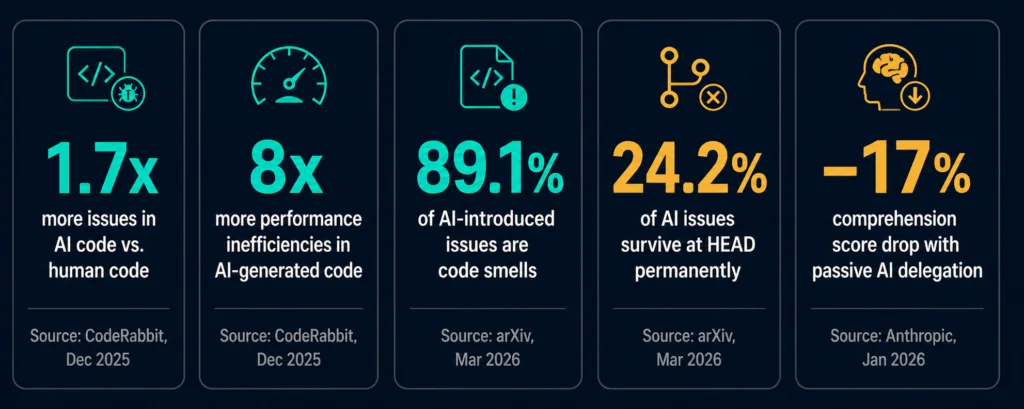
AI-generated code is “highly functional but systematically lacking in architectural judgment.”
The generative AI feature layer
Why the second rewrite won't work
The rewrite impulse is stronger than ever the codebase feels unfamiliar, AI-generated patterns conflict with the team’s original design, starting over feels like the only path back to coherence.
It’s a trap, 88% of business transformations fail to achieve original ambitions. Big Bang replacements feature-freeze the existing system while you rebuild what already exists.
And AI makes the rewrite itself worse. Refactoring has declined from 25% of changed lines in 2021 to less than 10% in 2024, while copy-paste patterns rose to 12.3%. A team that rewrites AI assistance will reproduce the same comprehension of debt just on a newer framework with less institutional knowledge.
The technology path: govern speed, don't reduce it
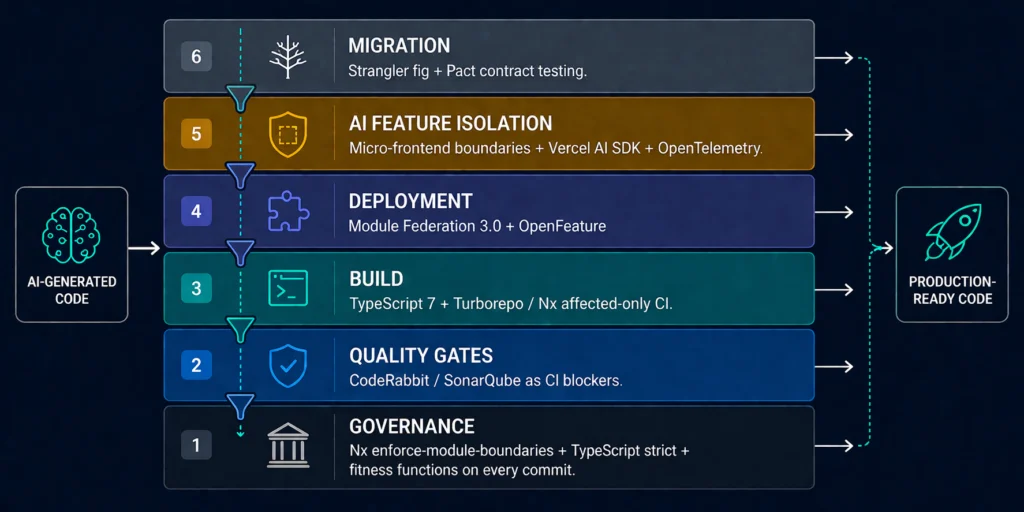
The architecture stack for AI-accelerated React codebases
- Governance: Nx with enforce-module-boundaries. TypeScript strict + @typescript-eslint/no-unsafe-*. Fitness functions on every commit.
- Quality gates: CodeRabbit or SonarQube as CI blockers.
- Build acceleration: TypeScript 7 (Project Corsa). Turborepo or Nx for affected-only CI.
- Deployment independence: Module Federation 3.0. OpenFeature for deploy-release decoupling.
- AI feature isolation: Micro-frontend boundaries. Vercel AI SDK or LangChain.js. OpenTelemetry + Grafana Tempo.
- Incremental migration: Strangler fig for legacy areas. Pact contract testing at module boundaries
Your codebase doesn't need a rewrite. It needs guardrails.
The scale wall in 2026 is not slow builds or broken CI. The new wall is comprehension the gap between the code AI generates at unprecedented speed and the architectural understanding needed to maintain it.
The data is clear: AI-generated code introduces 1.7x more issues, 89% of which accumulate as permanent debt. Comprehension scores drop 17% with passive AI delegation. Refactoring has declined to historic lows while copy-paste patterns rise.
The technology to govern this exists today. Module boundaries can be CI-enforced. Type safety can constrain AI output. Fitness functions can catch drift on every commit. AI features can be isolated at the deployment boundary. Organizations that instrument these guardrails compound AI’s productivity gains quarter over quarter. Those that don’t hit the 18-month wall where the codebase grows larger but slower.
The rewrite won’t save you. Guardrails will.
Frequently Asked Questions
What is comprehension debt?
The gap between how much code exists in a system and how much of it any human being genuinely understands. Unlike technical debt, which announces itself through friction, comprehension debt breeds false confidence the code compiles, tests pass, but nobody can explain why it works.
Why is this specific to React + TypeScript?
React’s unopinionated component model and TypeScript’s incremental strictness create exactly the conditions where AI-generated code can be locally correct and globally incoherent. Opinionated frameworks constrain AI output more naturally.
How do fitness functions differ from code review?
Fitness functions are automated, CI-enforced checks that run on every commit. Code review is human, periodic, and scales poorly against AI-generated volume. Fitness functions apply the same rules to AI and human code uniformly.